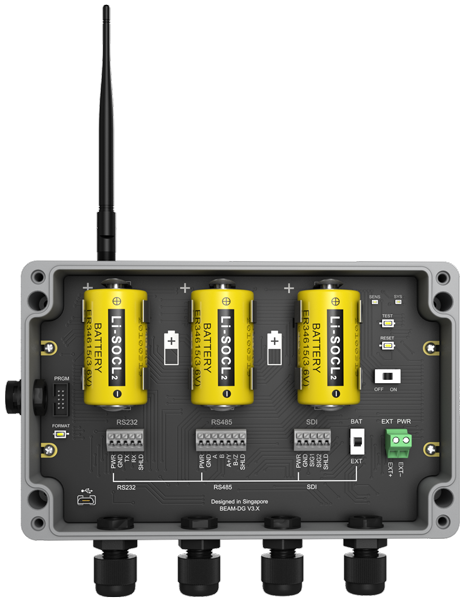
Geolook Digital Nodes
Universal wireless interface for digital sensors, supporting RS-485 (Modbus), RS-232, and SDI-12 protocols.
Visuals Uploading Soon
Our team is currently capturing high-res assets for this product.
Overview
Universal wireless interface for digital sensors, supporting RS-485 (Modbus), RS-232, and SDI-12 protocols.
The Geolook Digital Node (BEAM-DG) is designed to bring wireless connectivity to modern "smart" sensors. Unlike traditional analogue gauges, digital sensors process their data internally and output a digital string. This node acts as a transparent bridge, reading these complex digital signals and transmitting them via LoRa to the central gateway. It is the critical link for monitoring digital sensor chains, such as In-Place Inclinometers (IPIs) or ShapeArrays, where dozens of individual sensors are daisy-chained on a single cable. By handling protocols like Modbus RTU and SDI-12 natively, the BEAM-DG eliminates the need for cumbersome multiplexers and data loggers at the borehole head.
★ Benefits & Features
- Supports RS-485, RS-232, and SDI-12 protocols
- Reads digital chains (e.g., IPIs, SAA) with up to 100 segments
- Transparent Modbus RTU communication
- Smart power management for connected sensors
- Long-range LoRaWAN connectivity (up to 15km)
- IP67 Weatherproof aluminum enclosure
- Remote configuration of sensor addresses and polling cycles
Product Gallery
Explore the device from every angle
Gallery Uploading
High-resolution shots of this product are currently being processed.
Detailed Description
The Digital Shift
Geotechnical monitoring is moving toward digital sensors. Why? Because in a digital sensor, the conversion from 'physical phenomenon' to 'data' happens inside the sensor itself. This eliminates signal degradation over long cables.
The BEAM-DG preserves this precision. It doesn't interpret the reading; it simply transports the exact digital value from the bottom of the borehole to your cloud dashboard with zero error.
Environmental & Industrial Protocols
Beyond structural health, the BEAM-DG is a powerhouse for environmental monitoring. It natively supports SDI-12, the standard protocol for 'smart' environmental sensors.
This allows you to easily connect multi-parameter weather stations, soil moisture probes, or water quality sondes, integrating environmental data into the same platform as your structural safety data.
Eliminating Multiplexers
Traditionally, reading multiple sensors required a complex, expensive Multiplexer (MUX) box. The BEAM-DG effectively replaces the MUX. By leveraging the addressing capabilities of Modbus and RS-485, a single compact wireless node does the job that used to require a large cabinet of switching electronics.
Mastering Sensor Chains
The most powerful application of the BEAM-DG is reading 'Sensor Chains.' In deep excavations, engineers use In-Place Inclinometers (IPIs) consisting of 20, 30, or even 50 sensors connected in a single line.
Wiring 50 analogue sensors would require a massive cable bundle. With the BEAM-DG, you connect just four wires (Power and Data). The node cycles through every address on the chain, collects the data from all 50 depth levels, and transmits it in a single packet.
Smart Power Management
Digital sensors often require more power than passive analogue gauges. The BEAM-DG features an intelligent power scheduling system.
It keeps the external sensors powered off to save battery life. When a scheduled reading is due, it wakes up, powers the 12V bus, waits for a user-defined 'Warm Up' period to ensure stable readings, collects the data, and then powers everything down again.
The Digital Shift
Geotechnical monitoring is moving toward digital sensors. Why? Because in a digital sensor, the conversion from 'physical phenomenon' to 'data' happens inside the sensor itself. This eliminates signal degradation over long cables.
The BEAM-DG preserves this precision. It doesn't interpret the reading; it simply transports the exact digital value from the bottom of the borehole to your cloud dashboard with zero error.
Mastering Sensor Chains
The most powerful application of the BEAM-DG is reading 'Sensor Chains.' In deep excavations, engineers use In-Place Inclinometers (IPIs) consisting of 20, 30, or even 50 sensors connected in a single line.
Wiring 50 analogue sensors would require a massive cable bundle. With the BEAM-DG, you connect just four wires (Power and Data). The node cycles through every address on the chain, collects the data from all 50 depth levels, and transmits it in a single packet.
Environmental & Industrial Protocols
Beyond structural health, the BEAM-DG is a powerhouse for environmental monitoring. It natively supports SDI-12, the standard protocol for 'smart' environmental sensors.
This allows you to easily connect multi-parameter weather stations, soil moisture probes, or water quality sondes, integrating environmental data into the same platform as your structural safety data.
Smart Power Management
Digital sensors often require more power than passive analogue gauges. The BEAM-DG features an intelligent power scheduling system.
It keeps the external sensors powered off to save battery life. When a scheduled reading is due, it wakes up, powers the 12V bus, waits for a user-defined 'Warm Up' period to ensure stable readings, collects the data, and then powers everything down again.
Eliminating Multiplexers
Traditionally, reading multiple sensors required a complex, expensive Multiplexer (MUX) box. The BEAM-DG effectively replaces the MUX. By leveraging the addressing capabilities of Modbus and RS-485, a single compact wireless node does the job that used to require a large cabinet of switching electronics.
Available Models